What if healing is not something we think our way into, but also about experience?
So much of mental health support focuses on changing thoughts and while awareness matters, many people discover they understand why they feel anxious… but their body still feels unsafe.
This is where embodiment becomes powerful.
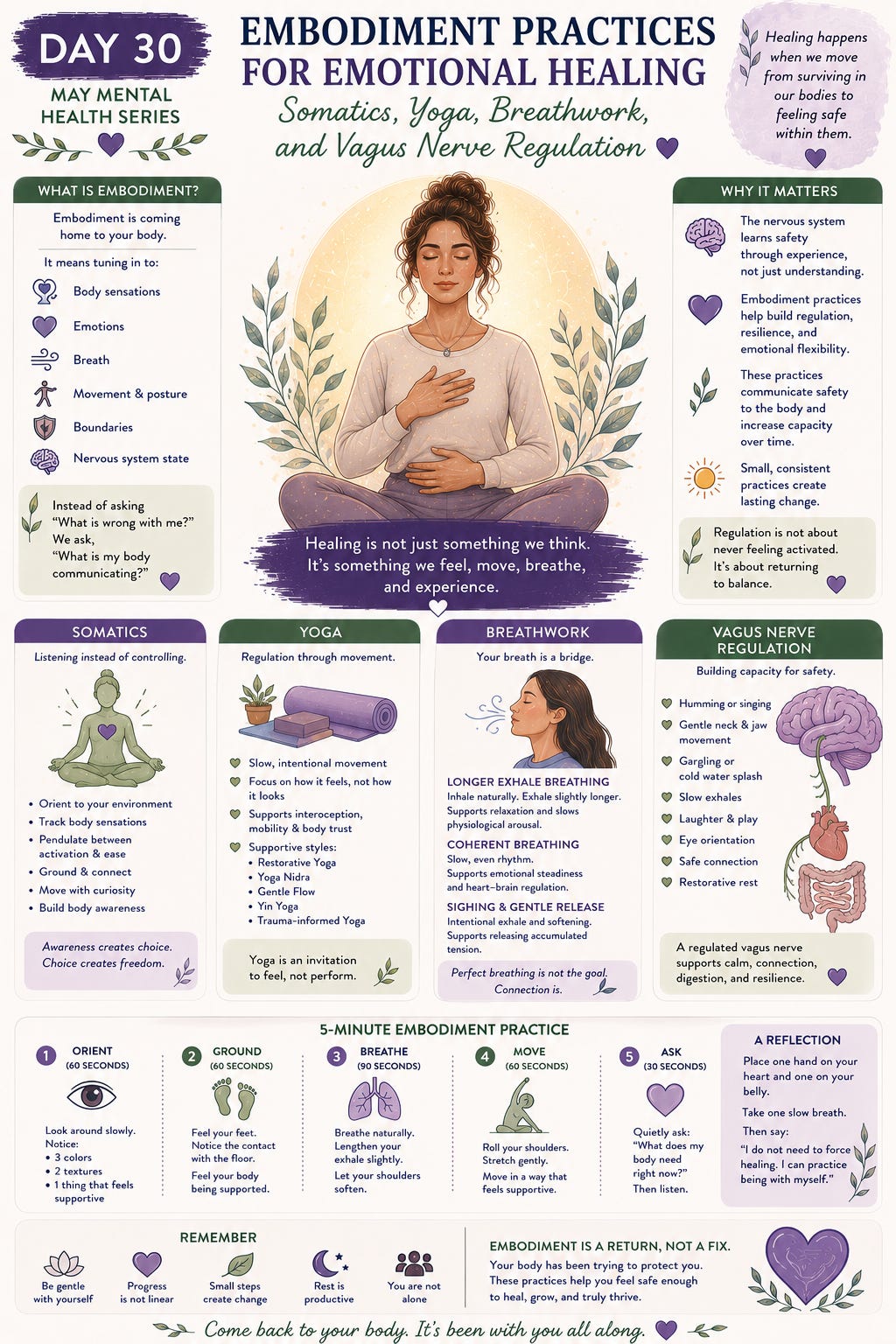
Embodiment is the practice of returning attention to the lived experience of being in your body. It is learning to notice sensations, emotions, movement, breath, boundaries, and internal cues not to fix them, but to become present with them.
For people living with anxiety, chronic stress, trauma, burnout, emotional overwhelm, grief, or nervous system dysregulation, embodiment practices may help create experiences of safety that words alone cannot always reach.
This does not replace therapy or medical care but reminds us that healing is not only cognitive, it is physiological.
What is Embodiment?
Embodiment means becoming connected to your internal experience.
It involves developing awareness of:
body sensations
emotions
breath
posture
movement
boundaries
nervous system state
Embodiment is communication with the body. The body is constantly providing information and sensations, healing often begins when we start listening.
The Nervous System Learns Through Experience
One of the most important ideas in nervous system healing is the body learns safety experientially. You cannot reason your way out of a survival response.
The nervous system responds more to:
rhythm
connection
breath
movement
sensation
environment
co-regulation
Embodiment practices work because they provide direct experiences of regulation.
Somatics and Sensations
The root word of somatic is ‘soma’ from the greek word, meaning ‘the physical body’. Somatics refers to practices that increase awareness of internal experience. Rather than forcing release or “getting rid” of emotions, somatic work invites compassion and curiosity to bodily sensations .
Somatic practices may include:
orienting to the environment
tracking body sensations
pendulation (moving between activation and ease)
grounding
noticing impulses
gentle movement
co-regulation
Somatic approaches support the understanding that emotions are not only thoughts but supporting bodily sensations.
Somatic Therapy Modalities include:
Somatic Experiencing (SE): Focuses on interoceptive (internal) and proprioceptive (physical awareness) sensations to process PTSD and other trauma-related symptoms.
Hakomi Method: A form of assisted self-study that combines mindfulness, somatic awareness, and the exploration of core beliefs.
Hanna Somatics: A form of neuromuscular (mind-body) re-education technique incorporating both verbal and hands-on movement instruction.
Feldenkrais Method: A form of somatic education that uses gentle, mindful movement to retrain the nervous system.
Yoga: Regulation Through Movement
Yoga can become a powerful embodiment practice when approached through regulation instead of performance. This can be a spiritual practice if you chose that to be the case or yoga can just be mindful and intentional movement practice.
This isn’t about the deepest stretch, how long you can be in a headstand, or how far you can contort your body into a back bend. As someone who is hypermobile and hyperflexible this isn’t something I strive for. I used to think that was an impressive quality - now I realize I was doing more harm than good to my bendy joints. Turning 50 can really put that into perspective - more is definitely not better - ouch!
Rather than striving for flexibility or intensity, nervous-system-supportive yoga emphasizes:
slow intentional movement
interoception (feeling internal sensations)
breath awareness
mobility
body trust
Supportive styles may include:
restorative yoga
Yoga Nidra (non-sleep deep rest)
gentle flow
trauma-informed yoga
yin yoga (proceed with caution if hypermobile - this focuses on connective tissue - use props for support)
Qoya (my personal movement preference - while not a traditional ‘yoga’ class, it is a wonderful movement practice that often incorporates a short yoga sequence)
Yoga becomes less about doing and more about feeling.
Breathwork: Communicating Safety to the Body
Breath is one of the most accessible ways to influence nervous system state. The breath acts as a bridge between conscious awareness and automatic physiology.
Box Breathing
Counteracts the body’s “fight-or-flight” response, lowers your heart rate, and decreases blood pressure.
inhale for a count of 4
hold for a count of 4
exhale for a count of 4
hold for a count of 4
Longer Exhale Breathing
Supports relaxation, slowing physiological arousal, and nervous system flexibility.
inhale naturally
exhale slightly longer
Coherent Breathing
Supports emotional steadiness and heart–brain regulation.
slow, even breathing rhythm
Maintain the rhythm: Do not hold your breath between inhales and exhales. Aim to keep this continuous, circular rhythm for 3 to 20 minutes
Sighing and Gentle Release
Supports releasing accumulated tension.
inhale naturally
intentional exhale (sigh) and softening
The goal is not perfect breathing but creating more options and as always, pay attention to your bodily response. What works for one person may be too activating for another.
Vagus Nerve Regulation: Building Capacity for Safety
The vagus nerve, also known as the ‘wandering’ nerve is a major communication pathway between the brain and body. It is the master regulator of the parasympathetic nervous system and directly influences your body's physiological capacity to self-regulate, recover from stress, and maintain overall resilience.
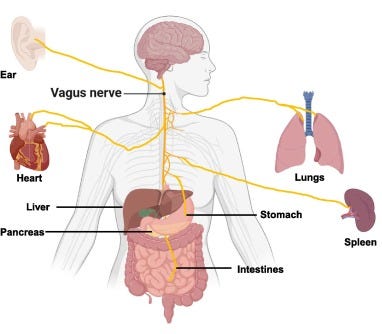
As the longest cranial nerve and a key part of the parasympathetic nervous system, it regulates many involuntary bodily functions, such as heart rate, respiratory rate, and digestion (Prescott and Liberles, 2022). The vagus nerve extends from the brainstem down to the abdomen, innervating various organs along its path, including the ears, heart, lungs, liver, pancreas, spleen, and parts of the GI tract like the stomach and intestines (Fig. 1).
Vagus nerve modulation can also occur naturally through physical exercise. Regular aerobic exercise is known to enhance vagal tone, which is the activity of the vagus nerve, leading to improved autonomic balance (Shanks et al., 2023). This increased vagal tone helps regulate heart rate, reduce inflammation, and promote relaxation. Exercise-induced VNS is associated with benefits for mental health, including reduced symptoms of depression and anxiety. The activation of the vagus nerve through exercise also supports overall cardiovascular health and enhances resilience to stress.
Supportive vagal practices include:
humming
singing
gentle neck movement
laughter
exhaling slowly
gargling
eye orientation practices
safe connection
restorative rest
Vagus nerve support is less about “hacking” the body and more about increasing capacity.
Healing is Not About Eliminating Activation
Many people begin embodiment practices hoping to never feel anxious again but healing is not becoming calm all the time.
Healing is developing flexibility.
Feeling activation… and knowing how to return
Feeling emotions… and staying connected
Experiencing stress… and recovering
Regulation is adaptability - riding the wave.
Urge Surfing
Urge suffering is a mindfulness concept for emotions, cravings, or urges. Observing these sensations like ocean waves: they rise, crest, and fall. Stay with the experience and observe the “waves” of sensations.
The Rise: Acknowledge an intense urge or emotion as it begins to build.
The Crest: The urge peaks in intensity and instead of acting (or reacting), you observe the feeling without judgment.
The Fall: You “ride” the wave as the emotion and sensations naturally subsides and fades on its own.
Small Practices Matter
The nervous system responds to repetition. Small practices done consistently often change more than intense efforts done occasionally.
One breath
One pause
One moment of noticing
One gentle movement
These moments accumulate.
A 5-Minute Embodiment Practice
1. Orient (60 seconds)
Slowly look around your environment.
Notice the following:
three colors
two textures
one thing that feels supportive
2. Ground (60 seconds)
Feel your feet
Notice contact with the floor
3. Breathe (90 seconds)
Breathe naturally
Lengthen the exhale slightly if that feels comfortable
4. Move (60 seconds)
Roll shoulders
Stretch gently
Let movement feel supportive
5. Pause (30 seconds)
Pause and connect with the moment
Nothing to change
Scan the body and see if you need any extra support
May Mental Health Series is coming to an end.
Somatics, yoga, breathwork, and vagus nerve practices offer pathways back into relationship with the body and sometimes emotional healing begins not by thinking differently but by gently coming home to ourselves.